How Drought Affects Real Estate
Drought is the one risk every property depends on — and almost nobody prices in. When it becomes a long-term supply problem, we call it water stress.
- Development halts — in parts of Arizona, new construction stopped for lack of a 100-year water supply
- Service cut-offs — some communities have lost municipal water deliveries outright
- Data center exposure — servers use millions of gallons per day to cool
- Agricultural loss — farm REITs carry direct crop-yield risk
- Utility cost surge — water rates rise sharply as supply tightens
- Demand ceiling — growth stalls where water supply hits a wall
- Lender repricing — mortgage underwriting starting to flag water risk
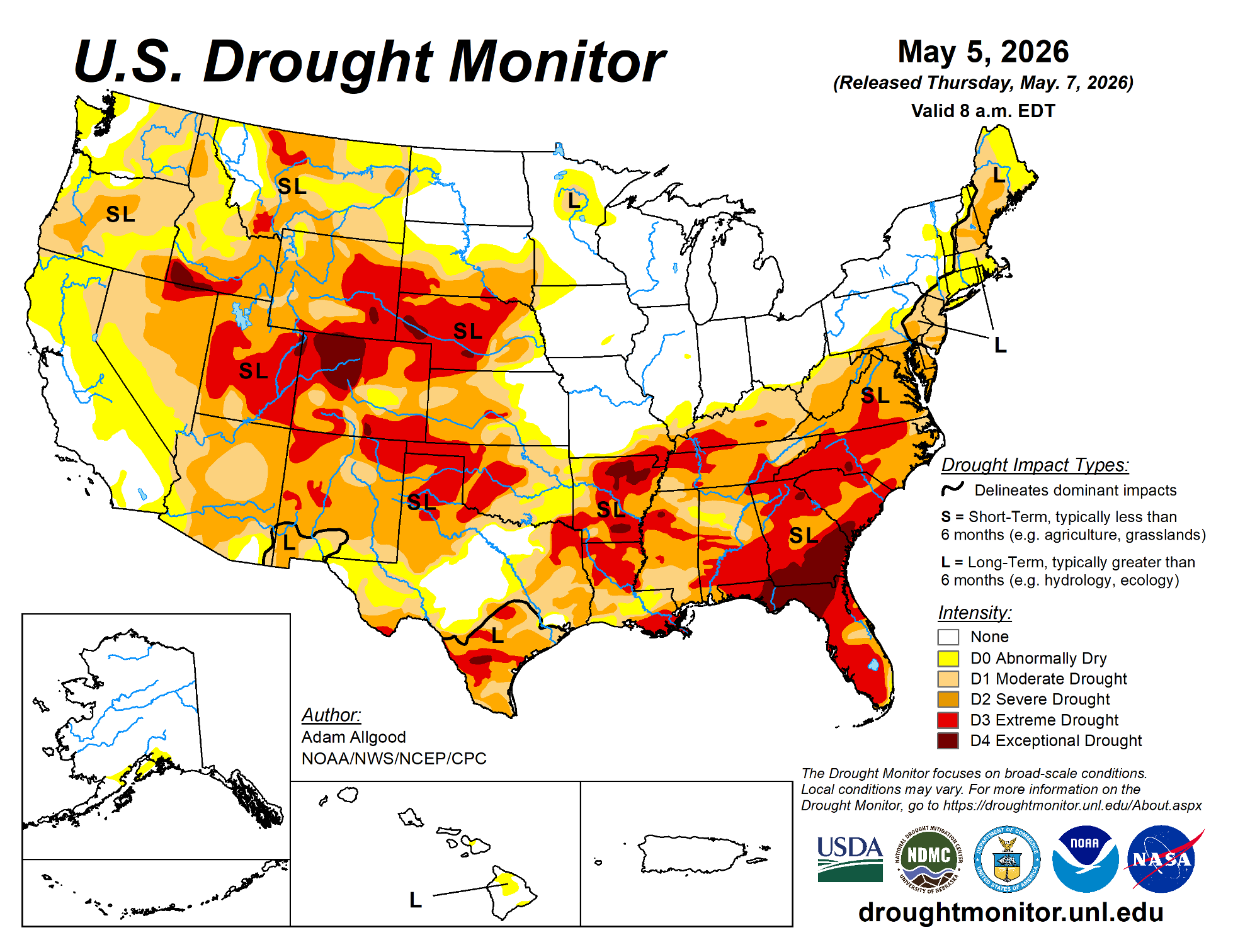
Location Is Everything
Water stress is uneven across the country. The U.S. Drought Monitor [1] — updated every week by NOAA, USDA, and the National Drought Mitigation Center — shows which parts of the country are in severe or exceptional drought right now. The western U.S. and southern Plains dominate the long-term picture, but drought has been expanding into the Midwest and Southeast.
Two REITs with Sun Belt exposure can have completely different water economics depending on which river basins and aquifers their properties actually depend on.
Source: U.S. Drought Monitor
What Drought Is — and Why It's Different Now
Drought happens when an area gets significantly less rain than normal over an extended period, depleting rivers, reservoirs, and underground water supplies. Short-term drought dries out crops. Long-term drought drains the aquifers that millions of homes and businesses depend on.
What's changed is permanence. The western U.S. has been in a megadrought — a drought lasting 20+ years — since around 2000. Research in Nature Climate Change found it's the driest 22-year period in at least 1,200 years, with roughly half its severity linked to climate change. [2] This isn't a dry spell waiting to end. It's a new baseline.
The Colorado River: A Case Study in Systemic Risk
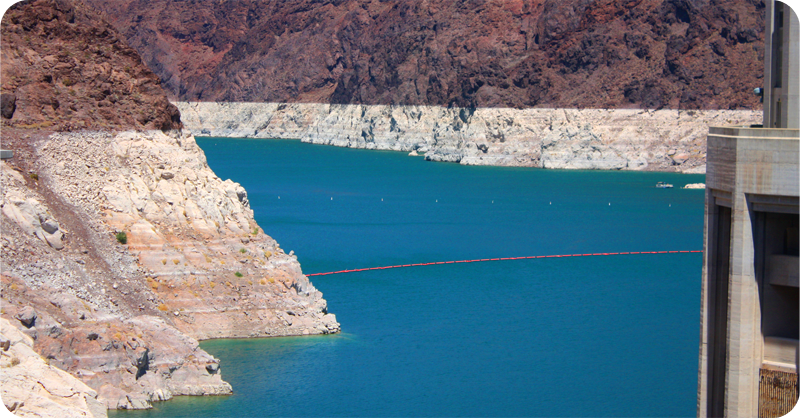
The bathtub ring at Hoover Dam: Source: Wikimedia Commons
Lake Mead looking toward Hoover Dam. The bright white band on the canyon walls — the "bathtub ring" — marks where the water level used to sit, more than 100 feet higher than recent lows. Every foot the lake drops is another round of allocation cuts to Arizona, Nevada, and California.
No story illustrates drought's threat to real estate better than the Colorado River. It supplies water to Arizona, Nevada, California, Colorado, Utah, Wyoming, and New Mexico — including Phoenix and Las Vegas, two of the fastest-growing real estate markets in the country.
Lake Mead, the river's largest reservoir, dropped to just 27% of capacity in July 2022 — its lowest level since it was filled in the 1930s. [3] The federal government declared the first-ever water shortage on the river that year, triggering mandatory cuts to Arizona and Nevada's water allocations.
The core problem: water rights on the Colorado were set in 1922, during one of the wettest periods in the river's recorded history. They assumed far more water than the river typically carries — and climate change is reducing that flow further. Seven states and 40 million people are staked on a system built for a climate that no longer exists.
When Water Stops Arriving
In parts of Arizona, new home construction has been halted because developers can't prove a 100-year water supply, as state law requires. In 2023, Rio Verde Foothills — a Phoenix suburb — had its water supply cut off entirely when Scottsdale stopped delivering water it could no longer spare. Hundreds of homeowners were left scrambling.
For REITs, drought exposure cuts across multiple asset classes. Data centers use millions of gallons per day to cool servers. Agricultural REITs are directly exposed to crop failures. Even residential REITs face headwinds when a community stops growing because water supply has hit a ceiling.
Lenders are starting to notice. Fannie Mae research has flagged water availability as an emerging risk in mortgage underwriting. [4] When major lenders start pricing water risk into loan terms, property values in constrained markets will feel it — the same way they felt it after flood risk was repriced post-Katrina.
What the Market Already Knows
Water isn't a named peril on most property policies — but lenders, utilities, and municipal bond buyers are still pricing it. Utility tariffs are rising. Municipal bonds tied to water-supply agencies are getting repriced. The World Resources Institute ranks 25 countries — home to 1.8 billion people — as facing extremely high water stress today. [5] Reinsurers and major asset managers have quietly added chronic water risk to their real estate analytics.
Insurance math, not politics
Water risk shows up in operating costs, development permits, and loan terms long before it shows up in the news. Lenders, utilities, and municipal bond buyers price it because the cuts, the moratoria, and the rate hikes are already landing.
Why This Matters
REITs — real estate investment trusts — own physical buildings in specific locations. An apartment REIT concentrated in Phoenix and Las Vegas has a different water-risk profile than one in the Great Lakes region. That's the property-level problem: where a building sits shapes what it's worth.
But portfolios have a second problem. A single bad year on the Colorado River doesn't hit one property — it tightens water budgets across every metro that depends on that river system at the same time. That's correlated risk: bets that look different but move together when the reservoirs drop.
The index underlying VNQ (Vanguard Real Estate Index Fund ETF), and most other U.S. real estate funds, weights REITs purely by market capitalization. It doesn't look at how much of a REIT's portfolio depends on the same shrinking aquifer, or how many REITs in the index share the same river basin.
The index methodology behind the Climate Global - Climate-Resilient REIT Index ETF (CLIM) is built differently. It uses the same catastrophe models insurers use — applied building by building across every REIT — and measures how much of a fund's exposure clusters on the same risk.
Learn more about Climate Global ETF. Click Here.>>
Sources:
[1] U.S. Drought Monitor. May 21, 2026. https://droughtmonitor.unl.edu/
[2] Williams, A.P., Cook, B.I. & Smerdon, J.E. Rapid intensification of the emerging southwestern North American megadrought in 2020–2021. Nature Climate Change 12, 232–234 (2022). https://doi.org/10.1038/s41558-022-01290-z
[3] Bureau of Reclamation. Lake Mead at Hoover Dam hourly elevation records. Accessed May 1, 2026. https://www.usbr.gov/lc/region/g4000/hourly/mead-elv.html; NASA Earth Observatory. “Lake Mead Keeps Dropping.” July 22, 2022. https://science.nasa.gov/earth/earth-observatory/lake-mead-keeps-dropping-150111/; Bureau of Reclamation. “Bureau of Reclamation Announces 2022 Operating Conditions for Lake Powell and Lake Mead.” August 16, 2021. https://www.usbr.gov/newsroom/#/news-release/3950
[4] Arizona Department of Water Resources. “Assured and Adequate Water Supply Programs Overview.” https://www.azwater.gov/aaws/aaws-overview; Arizona Department of Water Resources. “Phoenix AMA Groundwater Supply Updates.” https://www.azwater.gov/phoenix-ama-groundwater-supply-updates; Arizona’s Family / 3TV CBS 5. “City of Scottsdale cuts off Rio Verde Foothills residents from water supply.” January 2, 2023. https://www.azfamily.com/2023/01/02/city-scottsdale-cuts-off-rio-verde-foothills-residents-water-supply/; Fannie Mae. “Adverse Selection and Climate Risk.” March 30, 2021. https://www.fanniemae.com/media/44751/display
[5] Kuzma, S., Saccoccia, L. & Chertock, M. “25 Countries Face Extremely High Water Stress.” World Resources Institute. August 16, 2023. https://www.wri.org/insights/highest-water-stressed-countries; Kuzma, S. et al. “Aqueduct 4.0: Updated Decision-Relevant Global Water Risk Indicators.” World Resources Institute. August 2023. https://www.wri.org/research/aqueduct-40-updated-decision-relevant-global-water-risk-indicators
Carefully consider the Funds’ investment objectives, risk factors, charges and expenses before investing. This and additional information can be found in the Fund’s Prospectus and Summary Prospectus, which may be obtained by visiting www.climateglobaletf.com. Read the Prospectus and Summary Prospectus carefully before investing.
The Fund is distributed by Foreside Fund Services, LLC. Exchange Traded Concepts, LLC serves as the investment advisor. The Fund is distributed by Foreside Fund Services, LLC., which is not affiliated with Climate Global, Exchange Traded Concepts, LLC, or any of its affiliates.
Investing involves risk, including possible loss of principal. The Fund’s return may not match or achieve a high degree of correlation with the return of the Index. To the extent the Fund’s investments are concentrated in or have significant exposure to a particular issuer, industry or group of industries, or asset class, the Fund may be more vulnerable to adverse events affecting such issuer, industry or group of industries, or asset class than if the Fund’s investments were more broadly diversified. Issuer-specific events, including changes in the financial condition of an issuer, can have a negative impact on the value of the Fund.
A new or smaller fund is subject to the risk that its performance may not represent how the fund is expected to or may perform in the long term. In addition, new funds have limited operating histories for investors to evaluate and new and smaller funds may not attract sufficient assets to achieve investment and trading efficiencies.
Shares are bought and sold at market price (closing price) not net asset value (NAV) and are not individually redeemed from the Fund. Market price returns are based on the midpoint of the bid/ask spread at 4:00pm Eastern Time (when NAV is normally determined) and do not represent the return you would receive if you traded at other times. Brokerage commissions will reduce returns.
